

Solar eclipse sweeps across UK, parts of Europe
A rare total solar eclipse swept across parts of Europe on Wednesday, August 12, with millions of people watching as the Moon moved between Earth and the Sun.
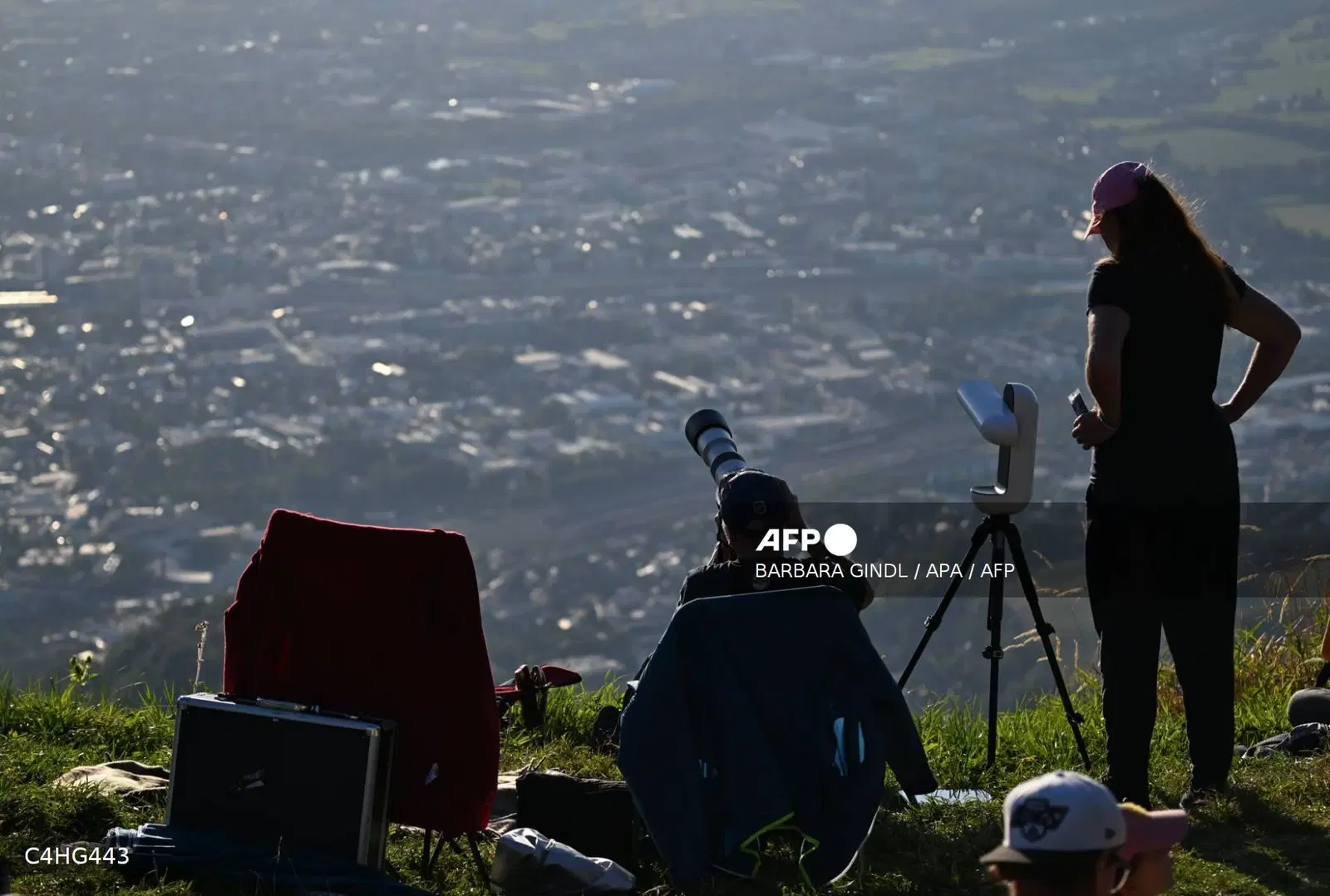
Millions of skywatchers across the United Kingdom and Europe turned their attention to the skies on Wednesday, August 12, as a rare solar eclipse crossed the region, creating a spectacular celestial display.
The eclipse was particularly significant because observers in parts of Spain, Iceland and other locations along the path of totality experienced a total solar eclipse, while people across the UK and much of western Europe witnessed a deep partial eclipse.
The event attracted large crowds at viewing locations, with astronomy enthusiasts, families and members of the public gathering outdoors to watch the Moon gradually move across the face of the Sun.
### A rare spectacle across Europe
A solar eclipse occurs when the Moon passes between the Earth and the Sun, temporarily blocking some or all of the Sun's light from reaching observers on Earth.
The August 12 eclipse was a total solar eclipse along a relatively narrow path that crossed parts of the Arctic region, Greenland, Iceland, the Atlantic Ocean and northern Spain, with the path also reaching northeastern Portugal.
Outside that narrow path, millions more people were able to see a partial eclipse as the Moon covered only part of the Sun.
The event was particularly notable for Europe because totality was visible from parts of the continent, producing moments when daylight briefly gave way to dramatically darker skies.
### UK witnesses a deep partial eclipse
People across the United Kingdom were unable to experience totality, but the eclipse was still an unusually deep one.
According to the Royal Observatory Greenwich, around 90 to 96 per cent of the Sun was covered by the Moon in different parts of the UK and Ireland. Parts of Europe, including France, Belgium, Switzerland and northern Italy, also experienced substantial coverage.
The depth of the eclipse meant that the event was noticeably different from an ordinary partial eclipse.
In London, for example, the eclipse began in the early evening, reached its maximum at around 7:12pm BST and ended shortly after 8pm.
### Crowds gather to watch
The unusual astronomical event prompted people across Britain and Europe to find suitable locations with clear views of the sky.
In London, observers gathered at locations including Primrose Hill, while other viewing events took place in parks, open spaces and astronomical observatories.
The event also generated widespread interest online, with photographs and videos showing the changing appearance of the Sun as the Moon moved across it.
In areas where totality occurred, the experience was considerably more dramatic, with the sky darkening and the Sun's bright outer atmosphere, known as the corona, becoming visible during the brief period of totality.
### Spain experiences totality
Northern and central parts of Spain were among the most prominent locations along the path of totality.
Several Spanish cities and regions were able to experience the Moon completely covering the Sun, creating a short period of darkness during what would otherwise have been daylight.
The eclipse was described as a historic event for Spain, with large crowds gathering in different parts of the country to witness the phenomenon.
The Spanish experience contrasted sharply with that of Britain, where the Moon covered almost all, but not all, of the Sun.
### Iceland among the best viewing locations
Iceland was another major destination for eclipse watchers.
The country fell directly within the path of totality, allowing observers to witness the complete disappearance of the visible solar disk for a brief period.
Astronomy enthusiasts travelled to Iceland and other locations along the path in anticipation of the event, with weather conditions playing an important role in determining the quality of individual viewing experiences.
The combination of Iceland's landscapes and the dramatic darkness produced by totality made the country one of the most visually striking locations for the eclipse.
### Safe viewing remains essential
Although solar eclipses are spectacular, looking directly at the Sun without appropriate protection can cause serious and permanent damage to the eyes.
Astronomers and scientific organisations therefore advised members of the public to use certified eclipse glasses or other approved solar viewing equipment.
Ordinary sunglasses are not considered sufficient protection for directly viewing an eclipse.
The same precautions apply when attempting to photograph the eclipse, as looking through an unprotected optical device can expose the eyes to concentrated sunlight.
### A major event for astronomy enthusiasts
The eclipse also provided an opportunity for scientists and astronomy enthusiasts to observe the Sun and its surrounding environment.
During totality, the Moon blocks the bright surface of the Sun, making the much fainter solar corona visible.
Researchers can use eclipse observations to study features of the Sun's outer atmosphere and other phenomena that are difficult to observe under normal conditions.
For amateur astronomers, meanwhile, the event offered an opportunity to photograph and document one of nature's most dramatic astronomical events.
### Why eclipses attract global attention
Solar eclipses have fascinated human societies for thousands of years.
The apparent movement of the Moon across the Sun is relatively brief, and total solar eclipses are visible only from a limited area of the Earth's surface.
That geographical limitation makes total eclipses particularly special.
Millions of people can experience a partial eclipse, but only those located within the narrow path of totality can see the Moon completely cover the Sun.
This difference was clearly visible during the August 12 event, with people in Britain experiencing a very deep partial eclipse while observers in Spain and Iceland witnessed totality.
### A memorable evening for skywatchers
The August 12 eclipse provided a rare opportunity for people across Europe to experience a major astronomical event without travelling outside the continent.
For those in the UK, the deep partial eclipse was one of the most significant solar events visible from the country in recent years, with some locations seeing more than 90 per cent of the Sun covered.
For observers within the path of totality, the experience was even more dramatic as the Moon completely obscured the Sun and temporarily transformed the daytime sky.
The event brought together millions of people across different countries, demonstrating the enduring fascination with astronomical phenomena.
As photographs and videos from the eclipse continue to circulate, the August 12 event is expected to remain one of the most memorable celestial spectacles witnessed across Europe in 2026.
Related News Reports

World
Four Pilots Killed as Two Philippine Air Force Training Planes Crash
TalkNaija Desk
2 min read
1

World
Trump Says He Ordered Lawsuit to Block Alaska Senate Result if Republican Loses
TalkNaija Desk
4 min read
5

World
Iran Warns US Warships Against Entering Persian Gulf Amid Renewed Strike Fears
TalkNaija Desk
3 min read
4

World
Kim Jong Un Orders North Korean Army to Build ‘World’s Strongest’ Military
TalkNaija Desk
3 min read
4

Reader Comments (1)
Adaeze Nwosu Verified Reader
Solid reporting. This is the kind of detail most outlets skip over — thank you for the context on the numbers.