

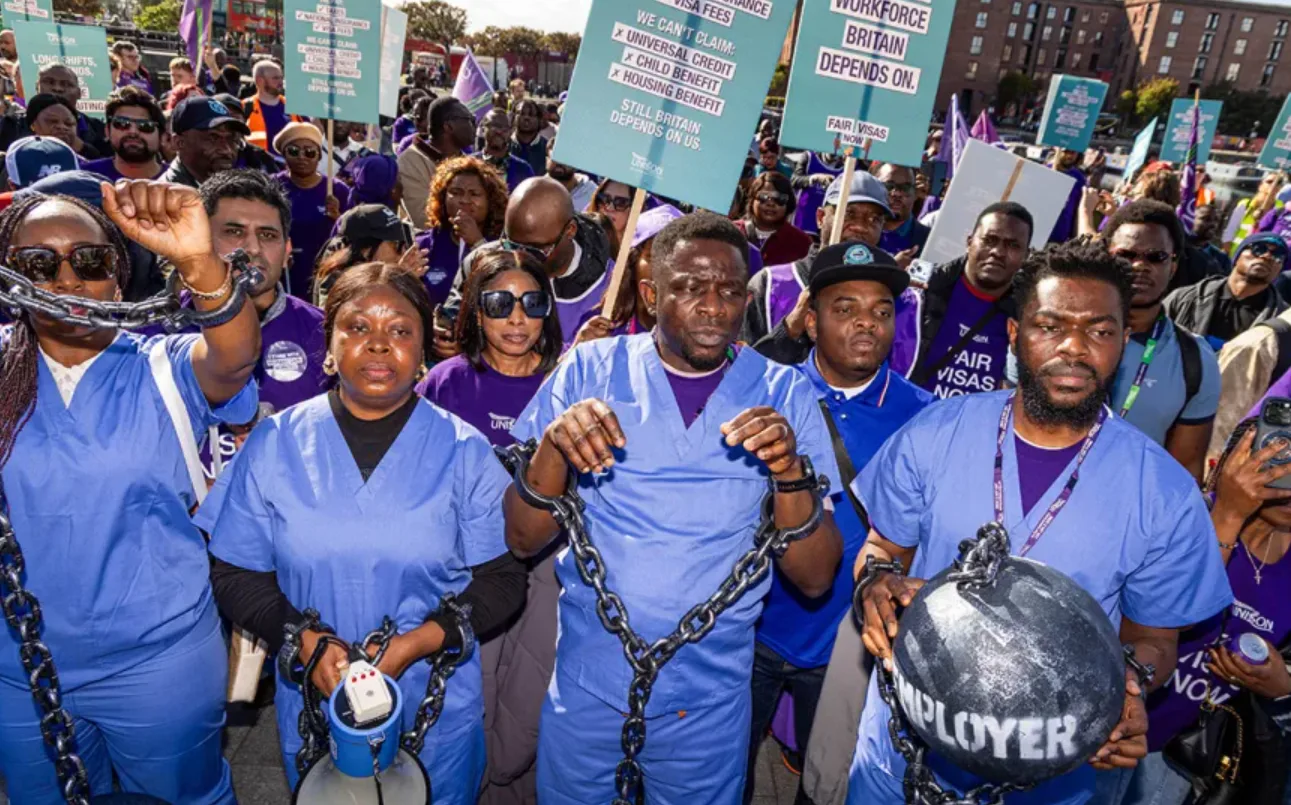
The demonstration, held on Monday, September 28, 2026, was organised as part of the Fair Visa Campaign led by UNISON, the UK’s largest trade union. According to the union, around 400 people attended, with many wearing chains and symbolic balls to represent the restrictions and uncertainty they say migrant workers face under employer-sponsored visas.
Videos shared by UNISON showed protesters singing Jailer, a song released by Nigerian singer Bukola Elemide, popularly known as Asa, in 2007 as part of her debut album. The song’s themes of oppression, control and resistance made it a fitting choice for the demonstration.
UNISON said the protest highlighted concerns that some migrant workers can become vulnerable to exploitation when their immigration status is closely tied to a particular employer. Workers may fear that leaving an abusive workplace or speaking out against poor conditions could affect their ability to remain in the country and their families’ future.
At the centre of the protest are proposals to reform the UK’s settlement system, which governs when eligible migrants can apply for indefinite leave to remain (ILR), the status that allows them to live permanently in the country.
Under proposals outlined by the UK government, the standard qualifying period for settlement would increase from five years to 10 years, with a possible 15-year waiting period for certain lower-paid workers, including people in some health and social care roles. The final rules and any transitional arrangements for people already living in the UK have not been settled.
UNISON is calling on the government to retain the five-year qualifying period for skilled workers. The union is also advocating a sector-wide visa sponsorship arrangement for social care workers, arguing that it would reduce their dependence on individual employers and make it easier to leave exploitative workplaces.
Speaking at the demonstration, UNISON General Secretary Andrea Egan argued that migrant workers should not be blamed for longstanding problems in public services. She pointed out that international staff play important roles in the National Health Service, social care and other essential sectors.
Egan criticised the prospect of extending the settlement period, saying it could leave workers facing years of uncertainty despite having moved to the UK to fill labour shortages and provide essential services. The union has urged ministers to reconsider the proposals and invest more effectively in public services.
The issue has particular significance for Nigerians, who have been among the nationalities recruited through the UK’s health and care visa routes in recent years. Home Office figures cited in the original report showed that 18,143 Nigerian nationals were granted visas for care worker and home carer roles in 2023.
However, the proposed settlement reforms should not be confused with an immigration rule already in force. The UK government published its earned-settlement consultation in November 2025, and the consultation closed in February 2026. In July, the government said it was still considering the responses and would announce its final model, including any transitional arrangements, after completing that process.
The proposals have also faced opposition within the governing Labour Party and from trade unions. Housing and communities secretary Angela Rayner has previously criticised plans to make permanent settlement more difficult for migrants already in the UK, while UNISON has continued to campaign against the proposed changes.
Home Secretary Shabana Mahmood has acknowledged concerns surrounding the reforms and said the government would seek to balance fairness to people who migrated legally with the interests of British citizens. A final decision on the settlement system was still awaited as of October 10, 2026.
For the workers who took part in the Liverpool demonstration, the use of Jailer was more than a musical tribute. It was a public expression of their concerns about job security, immigration restrictions and the possibility of spending many additional years waiting for permanent status.
The debate is expected to remain significant for migrant communities, including Nigerians working in Britain’s health and social care sectors, as the government determines how its settlement reforms will apply to existing and future visa holders.
Reporting by TalkNaijaMedia





Reader Comments (0)
No comments yet. Be the first to share your perspective on this report.