

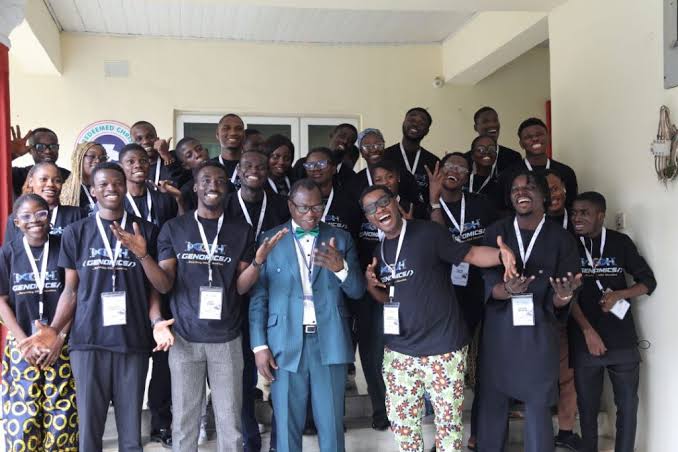
Held under the theme “From Genome to Impact: XR and AI Solutions for African Health,” the programme ran from September 28 to October 16, 2026, and concluded with a Demo Day at the IGH/ACEGID Auditorium on the university campus.
The hackathon focused on developing virtual reality learning experiences for polymerase chain reaction (PCR), a laboratory technique used to produce multiple copies of a selected DNA segment for analysis. The organisers divided the process into five stages, assigning each stage to a separate team to develop a prototype that could eventually become part of a connected learning platform.
Adedayo Okunfolami, Chief Information Technology and Innovation Officer at IGH and convener of the hackathon, said the development of emerging technologies must be guided by scientific accuracy, accessibility and clearly identified user needs.
He explained that genomics provides important insights into health and disease, while extended reality technologies offer new ways to demonstrate scientific concepts and simulate selected laboratory procedures.
The initiative forms part of IGH’s broader effort to expand access to genomics education and encourage more young people to pursue careers in science and technology.
At the centre of the project is GenomicsXR, an extended reality platform being developed to transform complex genomic activities into interactive learning experiences. Its first module, which focuses on DNA extraction, was deployed in 2025, while this year’s hackathon concentrated on PCR training.
Rather than requiring one team to develop the entire PCR simulation, organisers divided the workflow into five stages. The resulting prototypes are intended to cover different parts of the process, which will be reviewed and integrated into a single learning experience.
At the Demo Day, Adeleke Osho, Provost of the university’s Postgraduate School and lead judge, announced the final rankings. Team 5 emerged overall winner, followed by Team 2 in second place and Team 3 in third. Team 4 finished fourth, while Team 1 came fifth.
The next stage will involve reviewing the teams’ work, improving the prototypes and connecting their individual contributions so learners can navigate the PCR process through one continuous virtual experience.
The approach highlights the value of collaboration between scientific and creative disciplines. By bringing together people with different skills, the institute aims to develop learning tools that are scientifically reliable while remaining engaging and accessible to users.
The project could also help broaden access to genomics training, particularly for learners who have limited opportunities to observe or practise certain laboratory procedures. However, the virtual tools are intended to complement appropriate hands-on laboratory training rather than replace it entirely.
Through the GenomicsXR initiative, Redeemer’s University and IGH are exploring how locally developed technology can strengthen scientific capacity and contribute to the training of the next generation of African researchers.
Reporting by TalkNaijaMedia




Reader Comments (0)
No comments yet. Be the first to share your perspective on this report.